
Showing items filed under “The Rt. Rev. George Sumner”

Two Cheers for the Reformation!

main image

On a recent Sunday, we Celebrated the Feast of Christ the King.  But for many of our Christian neighbors it is known as ‘Reformation Sunday.’  What would such a designation mean to us, and to what extent would it be of value to us?  I am referring to more than simply liturgical style, since some of our readers pray in a way that seems to compel the question, while others do not.  For what it is worth, throughout much of Anglican history, our Church as a child of the Reformation was self-evident, but it is not so today.  Can we in our week-to-week Christian lives reclaim this legacy?  I want to offer two ways we can, and one aspect which makes this more problematic.

It is surprising for us to hear what worship was like in Europe just before the Reformation in the 16th  Century. The altars were hidden behind rood screens, the words of institution inaudible to most believers, the priests considered a breed apart (though people were aware, not least for satirists, that they didn’t deserve this!)  Worship accessible to all, the Scripture comprehensible in language:  all Churches nowadays, including the Romans, are children of the Reformation. Likewise the idea that we all have vocations, in church and the world, lay or ordained, derived too from the Reformation, is common currency.  An important aspect of our Book of Common Prayer is making the offices, Morning and Evening Prayer, available to all and not just to monks or priests.

I would call the second hurrah ‘seeing the forest for the trees.’  Luther and those who came after in the 16th  Century believe that the Church had always to grasp the nettle, to put the first thing first once again, to recall what Jesus called ‘the one thing needful.’ They were not the first to do this; such is a feature of all movements of renewal, including those before the 16th Century. The action of God ‘while we were yet sinners,’  called ‘grace’, which is alone sufficient to save us, is given the central place.  The Scriptures make this plain to anyone willing to listen, i.e. they are with respect to what matters most ‘clear.’  And the Church can have a good deal of latitude in ordering its life so long as it doesn’t lose sight of these (though it is always on the brink of doing just this).  This need to go ‘back to the source,’ to hear again the one thing needful is today shared by all Christians, however different their sense may be of how exactly to do the reclaiming.

 In these ways we should all rightly be sons and daughters of the Reformation. But in another we need to struggle against its legacy. We are too prone to settle into our own denominational ghetto, too prone to accept these differences as if they were competing franchises. We as Anglicans in particular, heedful of our divided history, have at our best made the search for the restoration to unity central to our identity.  In this way too, Reformation is our common legacy, but in this case as something to overcome (which incidentally the Reformers themselves realized).  May we bear all three features in this season.

Peace,

+GRS

In Honor of an Illustrious Anglican Forebear

main image

Since most of my ancestors were stern Yankee cow farmers, I lay claim to a Sumner more distant on the family tree. Mary Sumner was the wife of the Bishop of Winchester and sister-in-law of an Archbishop of Canterbury. But that is not what I want to highlight. First of all, she was a lay woman of deep faith, a kind of matron saint of clergy spouses. She had a strong sense of her own distinctive vocation.

Secondly, like so many in the 19th century she founded a voluntary Christian society. The Victorians were joiners, and ministered together in groups which augmented official structures. In her case she mobilized mothers (and eventually all women) to serve in the Mothers’ Union. She could not have foreseen that it would come to be called the ‘fifth instrument’ of global Anglicanism.

Third, she was well ahead of her time. She had a burden for young women trafficked in Dickensian London, and made ministry on their behalf a centerpiece of the MU in her time. Her public speaking on their behalf unsettled the powers that be.

Mary doesn’t have a day in the Sanctoral. So much the better. She was folk like you or me, and we can mean to be such a saint too. +GRS

12...74757677787980818283 ... 146147

Complete the Race (II Timothy 4:17)

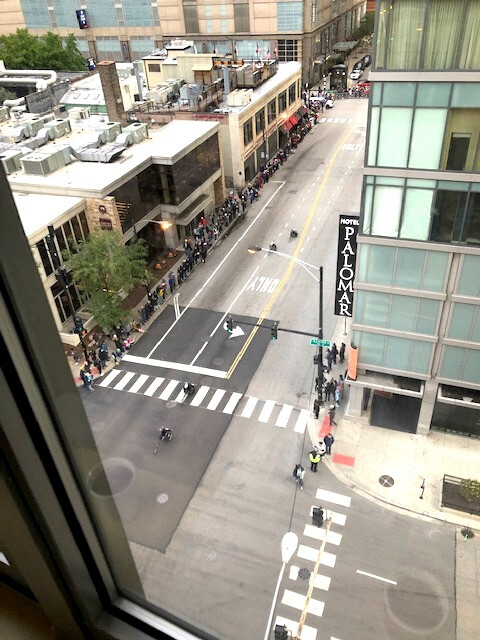
At the end of our vacation we find ourselves in Chicago for its Marathon weekend (the fastest, I have read this morning, perhaps because it is cool and relatively level). Marathons offer many good things. You can see world-class athletes from places like Ethiopia and Kenya. There is a feel of fiesta with signs by family members, getups by some for-fun runners, and food for sale.

But as I looked out my hotel window at 7:30 a.m., I watched the race of competitors who have lost legs or their use. Wheeling vehicles by arm for 26 miles means serious fitness and determination.

Those competitors were to me, this morning, a symbol of the Church too. For each is wounded. The larger family cheers them on. Each by grace has risen up to run the race. Ahead is the goal, the prize, the welcome home. We find the companionship of Jesus the Lord, there, and along the route too.

Amen.

GRS