
One of Those Very Religious Persons
About 20 of us were there for come-and-go breakfast. She was from Holland, about ten years younger than I. I had learned that Dutch folk tend to learn to mimic accents; she, certainly, could pass as an American when she was speaking English to me. And it came to the question, What do you do back in Texas? “I’m a priest in the Episcopal Church—it’s part of the Anglican Communion, originating in the Church of England; I’m anglicano.” She seemed surprised. She said, “So you’re one of those very religious persons.”
Later I wondered about the “very” in that sentence. Normally, I would hear “those very religious persons” as a slight, a negative characterization, like “You’re one of those people who are crazy about the history of Dr. Pepper,” for instance; as if I were a person who spent too much time with stuff that had no importance to real life. (It wasn’t she, but there was another peregrino who had recently spent time in Waco. I asked her if she had visited the Dr. Pepper museum. The answer was affirmative.) But from my Dutch fellow pilgrim, I think there was no slight intended. She was just stunned, surprised; I’m not sure she had ever talked with a priest before.
I had mentioned being at a conference; she asked what the conference was; I said it was in Christian ethics, sponsored by the academic society, the Society of Christian Ethics. She asked what that was. I started to explain the workings of the society, but she interrupted. “No, not that; what’s Christian ethics?”
We who are Christians can forget that there are vast groups of people who have no awareness of the meaning or the contemporary practice of Christianity; who find the idea of “Christian ethics” as impenetrable as the idea of “Christian algebra” or “Christian baking.” Ethics is real stuff, whereas (for many) Christianity is old superstitious thinking that does not connect with reality.
Yet she was walking the Camino. She was—is—an uplifting presence in a group, with helpful ideas and a positive attitude towards blisters and other afflictions of life. And here she is, drawn to make this walk along with, in effect, representatives of the whole human race. I’ve said it before: everyone is on the Camino. Yet on the Camino most people walk past the many churches, many crosses, even though we are all walking to what may be the grave of one of the apostles who walked and talked with Jesus.
Of course it’s not just other people who don’t get the big picture. I too am ignorant of much about Christianity, including its history on this Iberian peninsula on the southwest corner of Europe. These churches we walk past are mostly empty and often closed. In a city of five thousand people today there may be four large Catholic church buildings, each seating hundreds of people, but none ever actually seating even one hundred. An American thinks: these are redundant churches; some should be closed so that resources could be focused on preserving and building up the others. But I don’t live in a country that had church services nearly two thousand years ago. All those “extra” churches testify to a past when Christianity was very different from today, when people were different, when common assumptions could be made that are impossible now. What’s a strength? What’s a weakness? Were they better off? Are we better off? I don’t know. I wonder. I marvel.
I hope the Dutch woman gets a bit more Christian understanding as we move closer to Santiago. I hope that for all of us pilgrims.
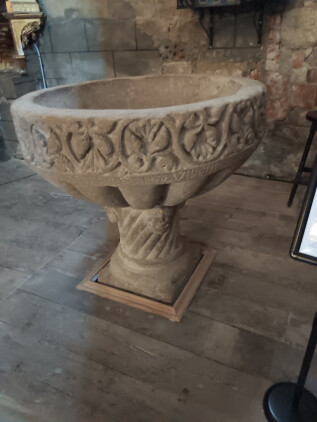
Photo: "Where Christianity is old: This font was used for baptisms about 1000 years ago. Today it is in the church of S. Juan Batista in Granon, Spain, on the Camino Frances."